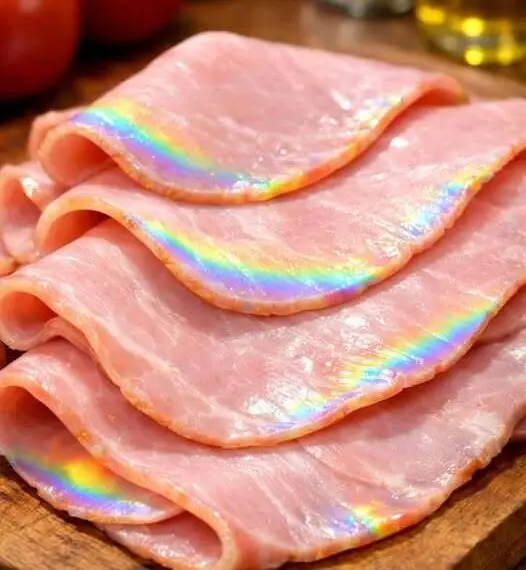
If you’ve ever opened a pack of deli ham and noticed a strange rainbow or iridescent shimmer on the surface, you’re not alone—and you’re probably wondering if it’s still safe to eat. The good news is that this colorful sheen is usually harmless. But in some cases, visual changes can signal spoilage. Understanding the difference is key to avoiding food waste while protecting your health.
Let’s break down what that rainbow effect really means, why it happens, and how to tell if your ham is safe or should go in the trash.
Why Does Ham Sometimes Look Rainbow-Colored?
That shiny, oil-slick appearance is called iridescence. It’s a physical phenomenon, not a chemical one, and it has nothing to do with artificial dyes or contamination.
The Science Behind It
Iridescence happens when:
- Light hits the surface of the meat
- The light reflects off microscopic layers of muscle fibers
- Different wavelengths bounce back at different angles
This creates the rainbow shimmer effect, similar to what you see on soap bubbles or butterfly wings.
What Causes It in Meat?
- Thin slicing (common in deli meats)
- Smooth, moist surfaces
- Uniform muscle fibers
- Strong overhead lighting
In short: It’s how light behaves—not a sign of rot.
According to food science research, iridescence is common in:
- Ham
- Roast beef
- Turkey
- Salmon
- Tuna
Is Rainbow Ham Safe to Eat?
In Most Cases: YES
If the ham:
- Smells normal
- Feels firm, not slimy
- Is within the expiration date
- Has been stored properly (below 4°C / 40°F)
Then the rainbow effect is purely visual and harmless.
The USDA and food safety experts confirm that iridescence does not indicate spoilage and does not affect nutritional value.
When Should You Worry?
While iridescence itself is safe, there are real signs of spoilage you should never ignore.
Throw It Away If You Notice:
Throw It Away If You Notice:
❌ Sour or sulfur smell
❌ Sticky or slimy texture
❌ Gray, green, or brown discoloration
❌ Mold spots (white, green, black fuzz)
❌ Expired date + poor refrigeration
If any of these appear with or without rainbow colors, the meat is no longer safe.
Why This Myth Persists
Many people associate unusual colors with bacteria or chemicals. In reality:
- Bacterial spoilage usually causes dullness, not shimmer
- Iridescence often appears on fresh, high-quality meat
- The effect disappears if you change the lighting angle
Ironically, the shinier the meat, the more likely it’s well-sliced and properly cured.
What About Bacteria and Health Risks?
Iridescence is not caused by:
- Salmonella
- Listeria
- E. coli
Those pathogens do not produce rainbow effects. They are invisible and detected through:
- Smell
- Texture
- Lab testing
That’s why visual inspection alone isn’t enough—but iridescence is not one of the danger signs.
How to Store Deli Ham Safely
To keep ham fresh and safe:
- Store at 0–4°C (32–40°F)
- Keep sealed in airtight packaging
- Consume within 3–5 days once opened
- Never leave out at room temperature for more than 2 hours
Proper storage prevents real spoilage—not harmless visual effects.
Fun Fact: Even Scientists Were Confused
Food researchers initially thought iridescence might indicate oxidation or chemical changes. Later studies using microscopy showed it’s simply light diffraction from aligned muscle fibers.
In other words:
Your ham isn’t glowing—it’s just bending light.
Final Verdict
Rainbow shimmer on ham is:
✔ Natural
✔ Harmless
✔ Common
✔ Not a sign of spoilage
Real danger signs are:
🚫 Smell
🚫 Slime
🚫 Mold
🚫 Expired storage
So next time you see that glossy rainbow shine, don’t panic. Tilt the slice under a different light angle and it will likely disappear—just like the illusion it is.
Sometimes food looks strange not because it’s bad, but because physics is showing off. 🌈🥩
