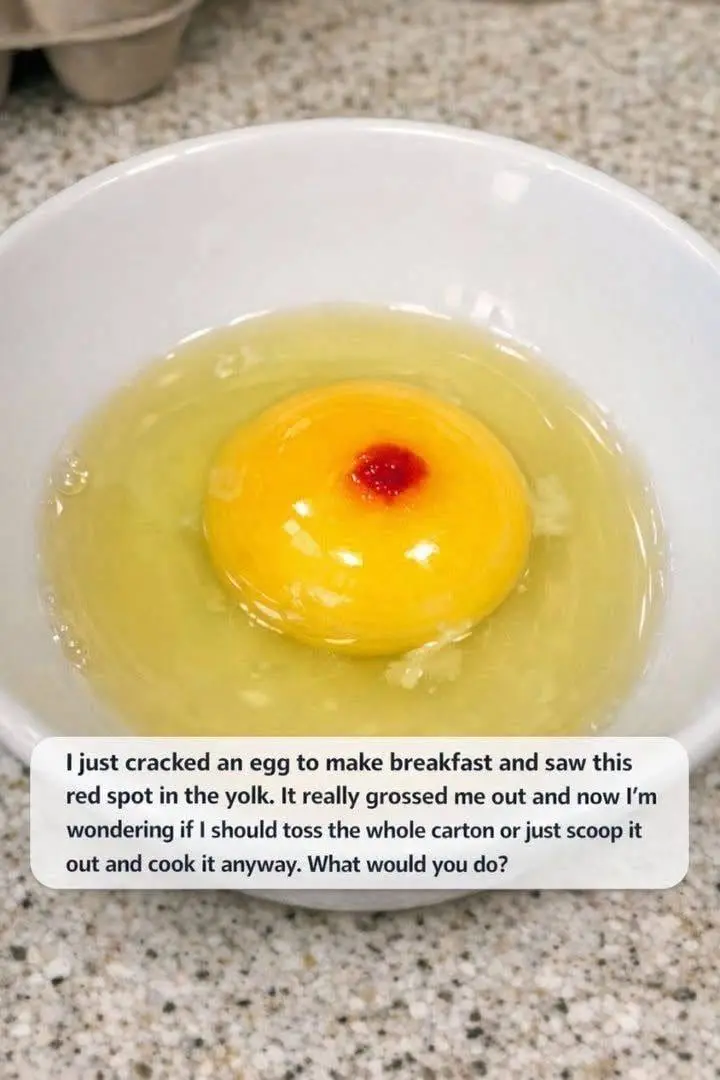
You crack an egg into a bowl, expecting to see a bright yellow yolk surrounded by clear egg white. Instead, you notice a small red or reddish-brown spot sitting on the yolk.
Your first reaction might be: “Is this egg bad?”
It is an understandable reaction. A red spot inside an otherwise normal-looking egg can be surprising, especially if you’ve never encountered one before.
The good news is that a small blood spot is usually not a sign that the egg is rotten.
🥚 What Is the Red Spot in an Egg?
The spot is commonly known as a blood spot.
It can occur when a small blood vessel in the hen’s reproductive tract ruptures during the formation of the egg. A tiny amount of blood can then become incorporated into the developing egg.
The spot may appear:
- Bright red
- Dark red
- Brownish
- Reddish-orange
Sometimes the spot is located directly on the yolk, while in other cases it can be found in the egg white.
Despite what the appearance might suggest, the presence of a small blood spot does not necessarily indicate that the egg is old or spoiled.
🩸 Why Does This Happen?
Egg formation is a natural biological process.
As an egg develops inside a hen, small blood vessels around the reproductive tissues can occasionally break. If this happens while the egg is forming, a tiny amount of blood may become trapped inside.
It is more likely to happen in some hens than others.
Factors such as the hen’s age, genetics and natural variation can influence how frequently these spots occur.
This is also why you may crack hundreds of eggs without seeing a single one and then suddenly encounter one.
❓ Does a Red Spot Mean the Egg Is Fertilized?
No.
This is one of the most common misconceptions about blood spots.
A blood spot is not evidence that an egg contains a developing chick.
Commercial table eggs are generally produced without fertilization, and a blood spot can occur regardless of fertilization.
The spot is simply associated with a small blood vessel breaking during egg formation.
🚨 Is an Egg With a Blood Spot Safe to Eat?
A small blood spot by itself is generally not a reason to throw the entire egg away.
If the egg has been properly stored and otherwise appears normal, you can remove the spot with the tip of a clean utensil if you find it unpleasant.
You should then cook the egg thoroughly.
However, the blood spot isn’t the only thing you should consider when deciding whether an egg is suitable for eating.
👃 Pay Attention to the Egg’s Smell
One of the most useful signs of spoilage is an unpleasant sulfur-like or rotten odor.
If an egg smells strongly unpleasant after cracking it, don’t try to rescue it simply because the yolk looks normal.
The safest approach is to discard it.
Remember:
A blood spot is different from an unmistakable sign of spoilage.
👀 Look at the Overall Appearance
A tiny red spot is generally very different from an egg that has obvious unusual discoloration, mold or other signs of deterioration.
When you crack an egg, look at the entire contents rather than focusing only on the red spot.
If something looks or smells clearly abnormal, it is better to throw the egg away.
🧊 Proper Storage Matters
Egg safety depends heavily on proper storage and handling.
Keep eggs refrigerated according to the storage instructions applicable in your country and avoid leaving them at room temperature for extended periods.
Also:
- Keep eggs in their original carton when possible.
- Avoid storing them where they are exposed to temperature fluctuations.
- Wash your hands after handling raw eggs.
- Avoid cross-contamination with ready-to-eat foods.
- Clean utensils and surfaces that come into contact with raw egg.
- Cook eggs thoroughly, particularly for young children, older adults, pregnant people and people with weakened immune systems.
🍳 Can You Simply Remove the Red Spot?
TO CONTINUE READING THE ARTICLE PLEASE SEE PAGE 2
🍳 Can You Simply Remove the Red Spot?
If the egg is otherwise fresh and properly stored, you can remove a small blood spot with the tip of a clean spoon or knife.
After that, the egg can be prepared normally.
Some people don’t mind the spot at all, while others prefer to remove it because of its appearance.
Either way, the spot itself isn’t necessarily a reason to discard an otherwise normal egg.
🥚 What About a Dark or Brown Spot?
Not every dark spot is necessarily blood.
Eggs can occasionally contain what are called meat spots, which may consist of tissue fragments or other material incorporated during egg formation.
These spots can range from brown to reddish or even grayish in appearance.
Again, the important thing is to evaluate the egg as a whole.
A small isolated spot in an otherwise normal egg is very different from an egg that has a foul odor or obvious signs of spoilage.
⚠️ When Should You Throw the Egg Away?
Don’t take chances if you notice clear signs that the egg may have spoiled.
Consider discarding it if:
- It has a strong rotten or sulfur-like smell.
- The shell was cracked and the egg was improperly stored.
- There is visible mold.
- The egg has unusual discoloration throughout its contents.
- It has been stored improperly or for an uncertain length of time.
- You are unsure whether it has remained at a safe temperature.
When in doubt about a questionable food, throwing it away is safer than taking a risk.
🔍 Why Does the Yolk Sometimes Have a Red Center?
In the photograph, the red spot is located prominently on the yolk, which can make it look particularly dramatic.
However, the location doesn’t necessarily make it more dangerous.
A tiny blood vessel can rupture during the egg’s development, leaving a localized spot of blood that becomes visible when the shell is opened.
The unusual appearance can make the egg look spoiled even when the actual issue is simply a natural variation in egg formation.
🌟 Don’t Judge an Egg Solely by One Tiny Spot
Eggs are biological products, and they’re not always perfectly uniform.
You may occasionally encounter:
- Double yolks
- Blood spots
- Meat spots
- Slightly different yolk colors
- Tiny irregularities in the egg white
These variations can look strange, but they don’t automatically indicate that something is wrong.
The important distinction is between natural variations and genuine signs of spoilage or contamination.
🍳 How to Handle Eggs Safely
Regardless of whether an egg has a blood spot, good kitchen hygiene is important.
When preparing eggs:
- Wash your hands before and after handling raw eggs.
- Keep raw eggs away from ready-to-eat foods.
- Use clean utensils and bowls.
- Refrigerate eggs appropriately.
- Avoid eating raw or undercooked eggs if you’re in a higher-risk group.
- Cook eggs until the whites and yolks are firm when following a conservative food-safety approach.
- Clean surfaces that have come into contact with raw egg.
The Bottom Line
So, what should you do if you crack an egg and discover a small red spot?
Don’t panic.
A small blood spot is usually a natural occurrence associated with the egg-forming process and does not, by itself, mean that the egg is rotten or that it contains a developing chick.
If the egg has been properly stored, has no unpleasant odor and shows no other signs of spoilage, the spot can simply be removed if you don’t want to eat it.
But if the egg smells bad, looks clearly spoiled or has been improperly stored, it’s better to discard it.
🥚 The next time you see a red spot…
Instead of immediately throwing away the entire carton, take a closer look.
That tiny red mark may be surprising—but it isn’t automatically a warning that your egg has gone bad.
The real key is to consider the egg’s storage history, smell, appearance and overall condition, and to practice safe handling and thorough cooking.
