As energy costs continue to rise each winter, many households are asking the same question: What’s the most economical way to heat your home during the night? Should you turn the heating off completely, or simply lower the temperature?
Experts in energy efficiency have studied this issue for years, and their answer is clear: there is a golden rule for reducing your heating bill without sacrificing comfort.
Below is everything you need to know to make the smartest choice for your home.
Should You Turn the Heating Off at Night?
Turning the heating off might seem like the best way to save money—after all, if it’s off, it’s not consuming energy.
But this strategy often backfires.
When a house cools down too much overnight, the heating system must work much harder in the morning to bring the temperature back up. This sudden energy demand can consume more energy than you saved while it was turned off.
When turning it off makes sense
You can turn it off if:
- You live in a well-insulated home.
- The outside temperature is mild, not freezing.
- You don’t mind waking up to a colder environment.
But for most homes—especially older ones—turning it off completely is not the most efficient choice.
Why Lowering the Temperature Is Better
Energy specialists agree:
✔ Lowering the thermostat at night is the ideal compromise.
Reducing the temperature by 2 to 4°C (about 3–7°F) is enough to save money while maintaining a stable indoor climate. This prevents your home from losing too much heat and avoids forcing the heating system to overwork in the morning.
The Golden Rule for Night Heating
Experts recommend the following nighttime settings:
Experts recommend the following nighttime settings:
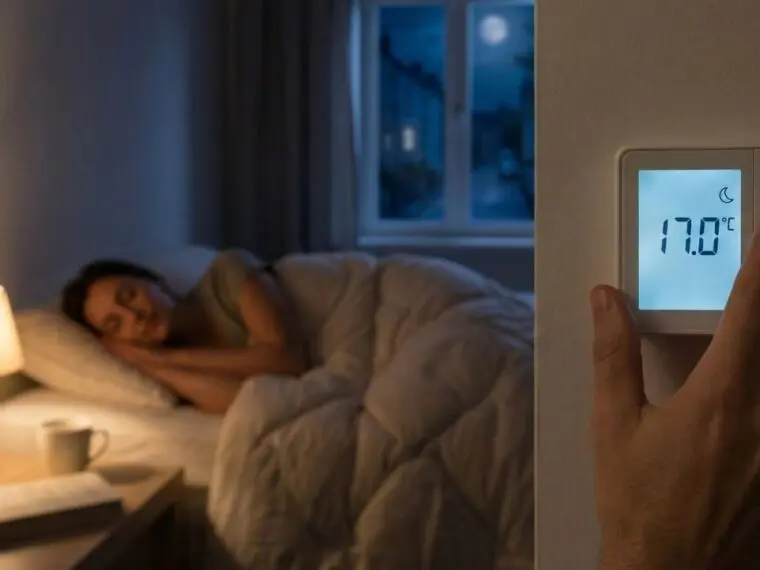
🌙 Optimal nighttime temperature: 16–18°C (60–64°F)
This range:
- Saves energy
- Keeps the home comfortable
- Promotes better sleep
- Reduces morning energy spikes
Studies have shown that each degree you lower your thermostat can reduce your energy bill by up to 7%.
Why Keeping Some Heat Is More Efficient
When your house loses heat gradually overnight, your heating system doesn’t need to compensate for extreme temperature differences in the morning.
Keeping it slightly warm helps:
- Maintain heat in walls and floors
- Reduce humidity
- Prevent pipes from getting too cold
- Stabilize the indoor climate
This is why heating experts insist on lowering, not shutting off, the system at night.
Smart Thermostats: The Perfect Ally
A programmable or smart thermostat can help significantly. It allows you to:
- Automatically lower the temperature at night
- Set the heating to rise again 30 minutes before you wake up
- Monitor consumption in real time
- Avoid overheating the house
These devices can reduce heating bills by 10–20% per year.
Additional Tips to Reduce Heating Costs
To maximize savings, experts recommend combining nighttime reduction with smart daily habits:
- Close curtains or shutters at night to retain heat
- Seal doors and windows against drafts
- Use rugs on cold floors
- Keep radiators clean and unobstructed
- Bleed radiators regularly for better efficiency
Small actions, big impact.
Final Verdict
If you want to save money without freezing at night, the winning solution is simple:
⭐ Do not turn off the heating completely. Lower it to 16–18°C for maximum efficiency and comfort.
This is the strategy energy experts call the golden rule for reducing heating bills, especially during colder months.
