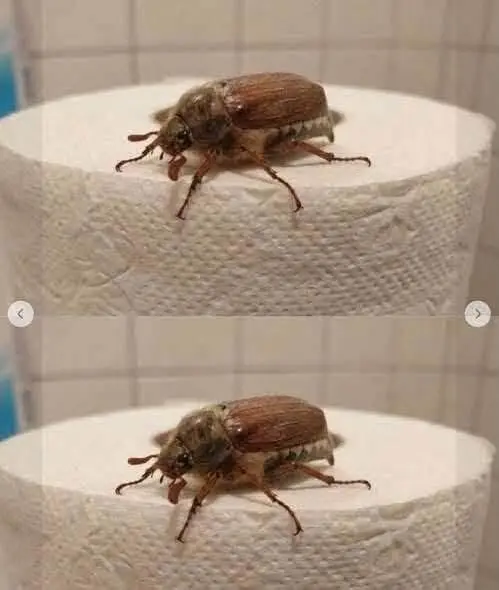
Finding an unfamiliar insect inside your home can be surprising—especially when it appears in an unexpected place, such as a bathroom, bedroom, kitchen, or even on a roll of toilet paper. The insect shown in the image appears to be a beetle, but identifying an insect from a single photograph can be difficult because many species have similar shapes and colors.
Rather than immediately reaching for an insecticide, there are a few simple and safe steps you can follow to determine what you have found and whether it actually poses a problem.
1. Don’t Panic—Most Household Insects Are Harmless
An unfamiliar insect can look alarming, but its appearance doesn’t necessarily mean your home is infested.
Many beetles and other insects accidentally enter homes while searching for:
- Food
- Shelter
- Warmth
- Moisture
- A place to hide
- A suitable location for reproduction
Some insects may simply wander indoors through doors, windows, cracks, ventilation openings, or gaps around plumbing.
Finding one insect does not automatically mean you have an infestation.
The first thing to determine is whether you’re seeing a single accidental visitor or multiple insects.
2. Look at the Insect Without Touching It
The safest approach is to observe the insect before handling it.
If possible, take a clear photograph from several angles. Try to capture:
- The entire body
- The head
- The antennae
- The legs
- The wings or wing covers
- The underside, if it can be photographed safely
- Its approximate size
A photograph next to a ruler or coin can also help establish its size.
Avoid picking up an unfamiliar insect with your bare hands. Some insects can bite or pinch when handled, while others may cause skin irritation.
3. Pay Attention to Its Body Shape
One of the easiest ways to begin identifying an insect is by looking at its overall body structure.
The insect shown in the photograph has several characteristics associated with beetles, including a relatively robust body and hardened-looking wing covers.
Beetles belong to the order Coleoptera, one of the largest groups of insects in the world.
Their front wings are modified into protective structures called elytra. These hard coverings protect the delicate flying wings underneath.
This is one of the major characteristics that distinguishes beetles from many other insects.
4. Check the Antennae
Antennae can provide useful clues when identifying insects.
Depending on the species, beetles may have antennae that are:
- Long and thin
- Short
- Thread-like
- Club-shaped
- Serrated
- Fan-shaped
The shape of the antennae can sometimes help narrow down the insect family.
However, identification should not be based on antennae alone. Several other characteristics should be considered at the same time.
5. Look at Where You Found It
The location where you discovered an insect can provide an important clue.
For example, insects commonly found around:
Kitchens
Possible attractions include food crumbs, grains, flour, cereals, dried foods, and other stored products.
Bathrooms
Moisture, drains, condensation, and sheltered spaces can attract certain insects.
Bedrooms
Some insects may simply enter through windows or hide in fabrics and dark areas.
Basements and garages
These areas often provide cooler, darker and more sheltered environments.
Gardens and balconies
Many beetles normally live outdoors and may occasionally wander inside.
The environment doesn’t identify the insect by itself, but it can help narrow down the possibilities.
6. Consider Its Size
Size is another important identification clue.
Before searching for the insect online, estimate its length.
For example:
TO CONTINUE READING THE ARTICLE PLEASE SEE PAGE 2
For example:
- Smaller than 5 mm
- Around 5–10 mm
- Around 1–2 cm
- Larger than 2 cm
A photograph can sometimes make an insect appear much larger or smaller than it really is, so including a familiar object for scale is extremely helpful.
7. Don’t Assume Every Brown Beetle Is a Cockroach
This is an important point.
People sometimes see a dark, brown insect with long legs and immediately assume it is a cockroach.
However, beetles, cockroaches and other insects can look surprisingly similar at first glance.
One useful clue is the structure of the wings and body.
Many beetles have distinct, hard wing covers that meet along the middle of the back. Cockroaches generally have a different body structure and wing arrangement.
That’s why it is better to identify the insect before deciding what pest-control method to use.
8. Take Several Photographs
If you want a reliable identification, don’t rely on one blurry image.
Take photographs showing:
Top view:
Shows the overall body shape and wing structure.
Side view:
Shows the height and shape of the body.
Close-up of the head:
Can reveal antennae and mouthparts.
Photo with a ruler:
Helps establish the insect’s actual size.
Good lighting is also important.
Try to avoid using a flash directly against a shiny insect because reflections can hide important details.
9. Use Identification Tools Carefully
There are many insect-identification applications and websites that can help identify insects from photographs.
They can be useful for generating possibilities, but an automated identification should not always be treated as definitive.
If the insect is potentially dangerous, if there are many of them, or if you suspect a significant infestation, consider contacting a qualified pest-control professional or local extension/entomology service.
10. Don’t Immediately Spray It With Insecticide
One of the biggest mistakes people make is treating an unknown insect before knowing what it is.
Unnecessary pesticide use can:
- Expose people and pets to chemicals
- Contaminate surfaces
- Harm beneficial insects
- Fail to address the actual source of the problem
- Create unnecessary expense
If you only found one insect, identification and observation are often a better first step.
11. Check Your Home for Entry Points
If you continue finding insects indoors, inspect the areas where they might be entering.
Look around:
- Doors
- Windows
- Window screens
- Plumbing openings
- Vents
- Cracks in walls
- Gaps around pipes
- Foundation openings
- Garage doors
Sealing obvious gaps can be an effective long-term strategy for preventing many accidental insect visitors.
12. Keep Food Properly Stored
If the insect appears to be associated with stored food, inspect your pantry.
Check products such as:
- Flour
- Rice
- Pasta
- Cereals
- Nuts
- Seeds
- Dried fruit
- Pet food
- Spices
Look for unusual insects, larvae, webbing, holes in packaging, or unexplained powder.
Store susceptible dry foods in airtight containers, particularly if you’ve previously experienced pantry pests.
13. Reduce Excess Moisture
If insects are repeatedly appearing in bathrooms, kitchens, basements or other damp areas, moisture may be contributing to the problem.
Simple measures include:
- Repairing leaking pipes
- Improving ventilation
- Drying wet areas
- Cleaning around sinks
- Addressing condensation
- Using a dehumidifier when appropriate
Reducing moisture can make your home less attractive to many moisture-loving insects.
14. What If You Find Several of Them?
One insect is often not a major concern.
But finding several insects repeatedly deserves more investigation.
Look for:
- Multiple insects in the same room
- Different life stages
- Larvae or nymphs
- Eggs
- Insects appearing every day
- Damage to food, fabrics or wood
- Insects emerging from cracks or hidden areas
These signs can indicate that the insects are reproducing nearby rather than simply entering from outdoors.
15. Don’t Forget the Outdoor Environment
Sometimes the source isn’t inside your home at all.
Outdoor vegetation, compost, firewood, mulch, garden debris and soil can support large insect populations.
An insect may simply enter the house accidentally through an open door or window.
If the insect is normally an outdoor species, removing it carefully and improving screens and entry barriers may be all that is necessary.
A Simple Safe Identification Checklist
When you discover an unfamiliar insect, ask yourself:
1. What does it look like?
Beetle, cockroach, moth, fly, ant, wasp, etc.
2. How large is it?
Measure it if possible.
3. Where did I find it?
Kitchen, bathroom, bedroom, garden, basement?
4. Was there only one?
Or are you seeing several?
5. Is there food, moisture or organic material nearby?
6. Are there signs of damage?
7. Can I photograph it clearly?
Answering these questions can make identification much easier.
What About the Insect in the Image?
The insect pictured appears to be a brown beetle-like insect, but the photograph alone isn’t sufficient to confidently identify its exact species.
The safest conclusion is therefore not to claim that it is a particular species without additional evidence.
Its presence on a roll of toilet paper also doesn’t necessarily indicate that the toilet paper itself is attracting the insect. It may simply have been a convenient surface for the insect to rest on.
If you encounter one like this, photograph it, note its approximate size and location, and observe whether additional specimens appear.
Final Thoughts
Discovering an unfamiliar insect in your home doesn’t necessarily mean something is seriously wrong.
The best response is identify first, act second.
Take a clear photograph, observe its physical characteristics, note where it was found, check whether more insects are present, and look for possible sources such as food, moisture or outdoor entry points.
Most importantly, avoid unnecessary pesticide treatments until you know what you’re dealing with.
A single unexpected insect may simply be an outdoor visitor. Repeated sightings, larvae, eggs or signs of damage are the clues that deserve closer attention.
