
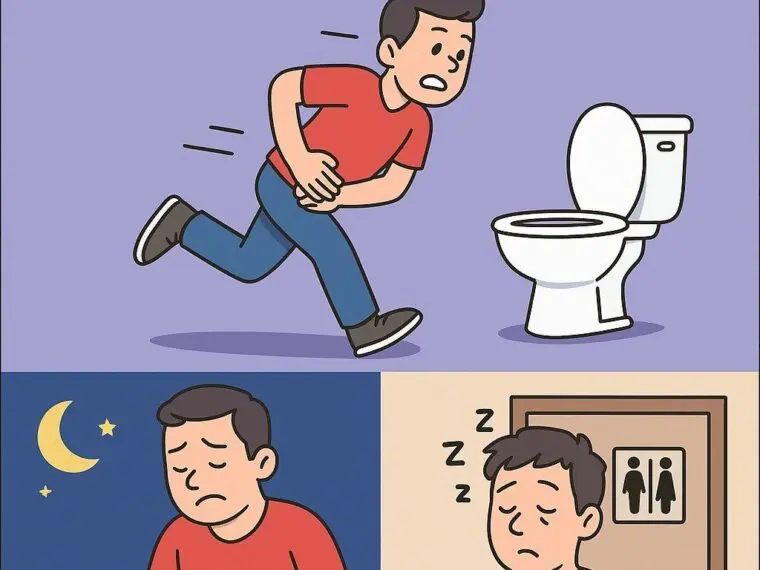
Waking up in the middle of the night to urinate is more common than you think. In the image, we see a man holding his lower abdomen, visibly uncomfortable, and heading toward the bathroom. This scenario represents a condition called nocturia, defined as the need to urinate one or more times during the night.
While many people assume this is simply a normal part of aging, research shows that nocturia can be a sign of an underlying health issue, lifestyle habits, or even specific physiological processes.
This article explores the science behind nocturia, its causes, risks, and what studies reveal about how to manage it.
1. What Is Nocturia? (Scientific Definition)
According to the International Continence Society (ICS), nocturia is the need to wake and pass urine at night one or more times.
Studies show:
- Up to 40% of adults over 40 experience nocturia.
- In people over 60, prevalence jumps to up to 70%.
- Even younger people may experience it due to lifestyle factors.
(Source: International Continence Society; Curr Urol Rep, 2018)
2. The Most Common Causes of Nighttime Urination
✔ 1. Excessive Fluid Intake in the Evening
Drinking large amounts of water, tea, or alcohol before bed increases urine production.
Study:
A 2019 study in BJU International showed that reducing evening fluid intake decreased nighttime bathroom visits by 28–40%.
✔ 2. Overactive Bladder (OAB)
Caused by involuntary bladder muscle contractions.
Symptoms:
- Urgency
- Frequent urination
- Small urine volumes
- Nighttime awakenings
Study:
A study in JAMA showed that 16% of adults suffer from OAB, and many experience nighttime symptoms.
✔ 3. Sleep Disorders (Especially Sleep Apnea)
This is one of the most overlooked causes.
When you stop breathing during sleep, pressure increases in the chest, triggering the release of atrial natriuretic peptide (ANP) — a hormone that increases urine production.
Study:
Research from the New England Journal of Medicine found that nearly 50% of people with sleep apnea experience nocturia.
Treating sleep apnea often reduces night urination significantly.
✔ 4. Diabetes or Prediabetes
High blood sugar forces the kidneys to produce more urine to eliminate excess glucose.
Fact:
Nocturia is one of the early signs of diabetes.
✔ 5. Enlarged Prostate (in Men)
Benign prostatic hyperplasia (BPH) can block urine flow, causing incomplete bladder emptying.
Study:
According to The Lancet, BPH affects 50% of men over 50, and nocturia is one of the first symptoms.
✔ 6. Hormonal Changes
As people age, production of vasopressin (a hormone that reduces nighttime urine output) decreases.
Lower vasopressin = more urine at night.
✔ 7. Certain Medications
Some drugs increase urination, especially:
- Diuretics
- Blood pressure medications
- Lithium
- Antidepressants
3. When Nocturia Becomes a Health Concern
You should seek medical advice if:
TO CONTINUE READING THE ARTICLE PLEASE SEE PAGE 2
You should seek medical advice if:
- You wake 2 or more times every night
- You feel extreme fatigue during the day
- Your sleep is consistently interrupted
- You experience pain or burning
Repeated nighttime awakenings increase risks for:
- Cardiovascular issues
- Cognitive decline
- Depression
- Falls (especially in the elderly)
A Harvard study found that chronic nocturia is associated with 17% increased risk of mortality, mainly due to sleep disruption.
4. Evidence-Based Solutions (What Studies Recommend)
✔ Reduce fluid intake after 7 PM
Especially alcohol and caffeine.
✔ Treat sleep apnea
CPAP treatment reduces nocturia episodes by up to 60%.
✔ Check blood sugar levels
To rule out diabetes.
✔ For men: evaluate prostate health
✔ Avoid salty foods in the evening
Salt increases fluid retention, which is released at night when lying down.
Study:
A 2017 study in European Urology showed reducing salt intake lowered nighttime urination frequency by up to 35%.
5. Natural Ways to Reduce Nighttime Urination
- Go to bed slightly earlier
- Elevate legs for 30 minutes before sleep (helps reduce fluid pooling)
- Empty your bladder twice before bed
- Maintain a healthy weight (reduces bladder pressure)
Conclusion
Nocturia is not just an inconvenience — it’s a symptom with many possible causes, from lifestyle habits to medical conditions like diabetes, sleep apnea, or prostate enlargement.
Understanding why you wake at night to urinate is the first step toward improving your sleep, protecting your long-term health, and regaining your quality of life.
