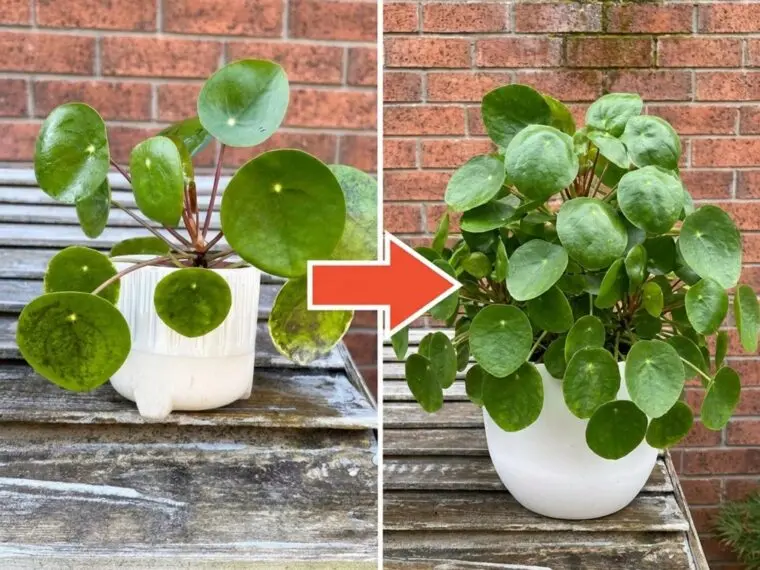
The Chinese Money Plant (Pilea peperomioides) is one of those houseplants that can instantly brighten a room. With its round, coin-shaped leaves, slender stems, and compact growth habit, it looks elegant without demanding complicated care.
Although Pilea is relatively easy to grow, a few simple details—especially light, watering, drainage, and potting mix—make a huge difference between a plant that merely survives and one that produces lots of healthy new leaves and offsets.
🌿 1. Give Your Pilea the Right Light
Pilea peperomioides prefers bright, indirect light.
A position near an east- or west-facing window is often ideal. Near a south-facing window, place it a little farther away or use a sheer curtain if the sunlight is intense.
Signs your Pilea needs more light:
- Stems become long and stretched.
- Leaves become smaller.
- The plant leans strongly toward the window.
- New growth becomes sparse.
Signs of too much direct sunlight:
- Leaves develop pale or bleached patches.
- Brown, crispy areas appear.
- Foliage may curl or look stressed.
Tip: Rotate the pot every week or two so the plant grows more evenly instead of leaning toward one direction.
💧 2. Water Only When It Needs It
One of the biggest mistakes with Pilea is watering too frequently.
Rather than following a strict calendar, check the soil first. Allow the upper portion of the potting mix to dry before watering again.
When you water:
- Water thoroughly.
- Allow excess water to drain from the bottom.
- Empty any water sitting in the saucer.
- Wait until the soil has partially dried before watering again.
Overwatering can leave the roots sitting in constantly wet soil, which can contribute to root rot.
On the other hand, allowing the plant to remain completely dry for long periods can cause leaves to droop, curl, or fall.
🪴 3. Use a Pot With Drainage
Your Pilea will be much easier to care for if its container has drainage holes.
A decorative pot without drainage can trap excess water around the roots.
A simple combination works well:
Pot with drainage holes + well-draining potting mix + saucer
The exact pot size isn’t as important as good drainage. Avoid moving a small Pilea into an enormous container because the excess soil can stay wet for too long after watering.
🌱 4. Choose an Airy Potting Mix
Pilea doesn’t need an exotic soil mixture.
A quality indoor potting mix amended with material that improves drainage and aeration can work very well.
For example, you can combine:
- Indoor potting soil
- Perlite or pumice
- A small amount of orchid bark or another coarse material
The goal is a mixture that holds enough moisture for the plant while allowing excess water to escape.
🌡️ 5. Keep It Comfortable
Chinese Money Plants generally enjoy normal indoor temperatures.
Keep your Pilea away from:
- Cold drafts
- Air-conditioning vents
- Heating radiators
- Very hot windows
- Sudden temperature changes
You don’t need to create a tropical greenhouse environment. A comfortable indoor location with reasonable humidity is usually sufficient.
💨 6. What About Humidity?
Pilea can tolerate ordinary household humidity, so you don’t necessarily need a humidifier.
If the air in your home is extremely dry, particularly during winter, you may notice leaf edges becoming dry or crispy.
Instead of constantly misting the leaves, consider improving overall room humidity with a humidifier if necessary.
Important: Good airflow is also valuable. Extremely humid, stagnant conditions can encourage fungal and other plant problems.
🌿 7. Fertilize During Active Growth
TO CONTINUE READING THE ARTICLE PLEASE SEE PAGE 2
🌿 7. Fertilize During Active Growth
During spring and summer, when your Pilea is actively producing new growth, a balanced houseplant fertilizer can provide useful nutrients.
Use a diluted fertilizer according to the product’s instructions rather than assuming that more fertilizer will produce faster growth.
Too much fertilizer can cause salt buildup in the soil and damage roots.
During periods of slow growth, particularly in darker winter conditions, the plant generally needs less fertilizer.
✂️ 8. Pruning Your Pilea
Pilea usually doesn’t require heavy pruning.
Remove:
- Completely yellow leaves
- Dead or badly damaged foliage
- Weak or unwanted growth
Always use clean scissors or pruning shears.
If the plant becomes very uneven, pruning can help encourage a more attractive shape, especially when combined with regular rotation.
🌱 9. One of the Best Things About Pilea: Baby Plants!
A mature Pilea can produce small offsets or “pups” around the base of the plant.
This is one reason Chinese Money Plant owners often become obsessed with the species!
When a baby plant has developed sufficiently, it can sometimes be separated carefully from the mother plant and grown in its own container.
This makes Pilea an excellent plant for sharing with friends and family.
Basic propagation idea:
- Wait until the offset has developed enough to survive independently.
- Carefully remove or separate it while minimizing root damage.
- Place it in a small pot with an appropriate, well-draining mix.
- Keep the soil lightly moist while it establishes.
- Provide bright, indirect light.
Avoid rushing the process. A larger, well-established offset generally has a better chance of adapting successfully.
🍃 10. Why Are the Leaves Curling?
Curling leaves can have several causes.
Check the plant’s environment if you notice this problem.
Possible causes include:
- Soil becoming too dry
- Excessive direct sunlight
- Heat stress
- Cold drafts
- Root problems caused by excessive moisture
- Pest activity
Don’t automatically add more water. Check the soil and roots first.
🟡 11. Why Are Pilea Leaves Turning Yellow?
A yellow leaf doesn’t always mean something is seriously wrong.
Older leaves naturally age and eventually turn yellow before falling.
However, multiple yellow leaves appearing at once can indicate a problem, particularly if the soil remains wet for a long time.
Check:
- How often you’re watering
- Whether the pot drains properly
- Whether the soil stays wet
- Whether the plant receives adequate light
- Whether there are signs of pests or root damage
🐜 12. Watch for Common Houseplant Pests
Pilea can occasionally attract common indoor plant pests such as:
- Spider mites
- Mealybugs
- Aphids
- Scale insects
Inspect the undersides of leaves and around stems, especially when bringing new plants into your home.
If you discover pests, isolate the affected plant from other houseplants and treat the infestation using an appropriate method for the pest involved.
Regular inspection is much easier than dealing with a major infestation later.
🌿 13. Should You Cut Off Large Leaves?
Not necessarily.
Healthy leaves are producing energy for the plant, so there is usually no reason to remove them simply because they are large.
Remove a leaf when it is:
- Dead
- Seriously damaged
- Diseased
- Completely yellow and no longer useful to the plant
Healthy foliage is an asset, not something that needs to be constantly trimmed.
🪴 14. When Should You Repot?
Pilea doesn’t need to be repotted constantly.
Consider repotting when:
- Roots are coming through the drainage holes.
- The plant dries out unusually quickly.
- Growth has slowed despite good care.
- The soil has broken down and drains poorly.
- The plant has become significantly root-bound.
Move up only one pot size at a time rather than jumping into a huge container.
After repotting, give the plant time to adjust rather than immediately applying lots of fertilizer.
☀️ 15. The Secret to a Beautiful, Full Pilea
If you want your Chinese Money Plant to look fuller and healthier, focus on consistency rather than complicated tricks.
The basic formula is:
Bright indirect light + sensible watering + excellent drainage + occasional feeding + regular rotation.
That’s it.
You don’t need dozens of special products or complicated routines.
🌿 Common Pilea Care Mistakes to Avoid
❌ Watering on a fixed schedule
Your plant doesn’t know it’s “Sunday.” Check the soil instead.
❌ Keeping the roots constantly wet
Poor drainage is one of the easiest ways to create root problems.
❌ Putting it in harsh midday sunlight
Too much direct sun can scorch the foliage.
❌ Keeping it in a very dark corner
Insufficient light can lead to weak, stretched growth.
❌ Using an oversized pot
Too much wet soil around a small root system can create problems.
❌ Overfertilizing
More fertilizer does not necessarily mean more growth.
❌ Ignoring the undersides of leaves
Pests often hide where they’re difficult to see.
🌱 Final Thoughts
The Chinese Money Plant (Pilea peperomioides) is a fantastic choice for anyone who wants an attractive indoor plant without an overly complicated care routine.
Its distinctive round leaves give it plenty of character, while its ability to produce baby plants makes it especially rewarding to grow. Once you understand its basic needs—bright indirect light, careful watering, good drainage, and occasional feeding—keeping a Pilea healthy becomes surprisingly simple.
And when your plant starts producing little babies around its base, you have the perfect opportunity to grow your collection or share a new plant with someone else.
Sometimes the best plant-care “secret” isn’t a special homemade remedy—it’s simply giving the plant the conditions it naturally prefers and avoiding the temptation to overcare for it.
